

Mysore pak: From the royal kitchens of the Kingdom of Mysore
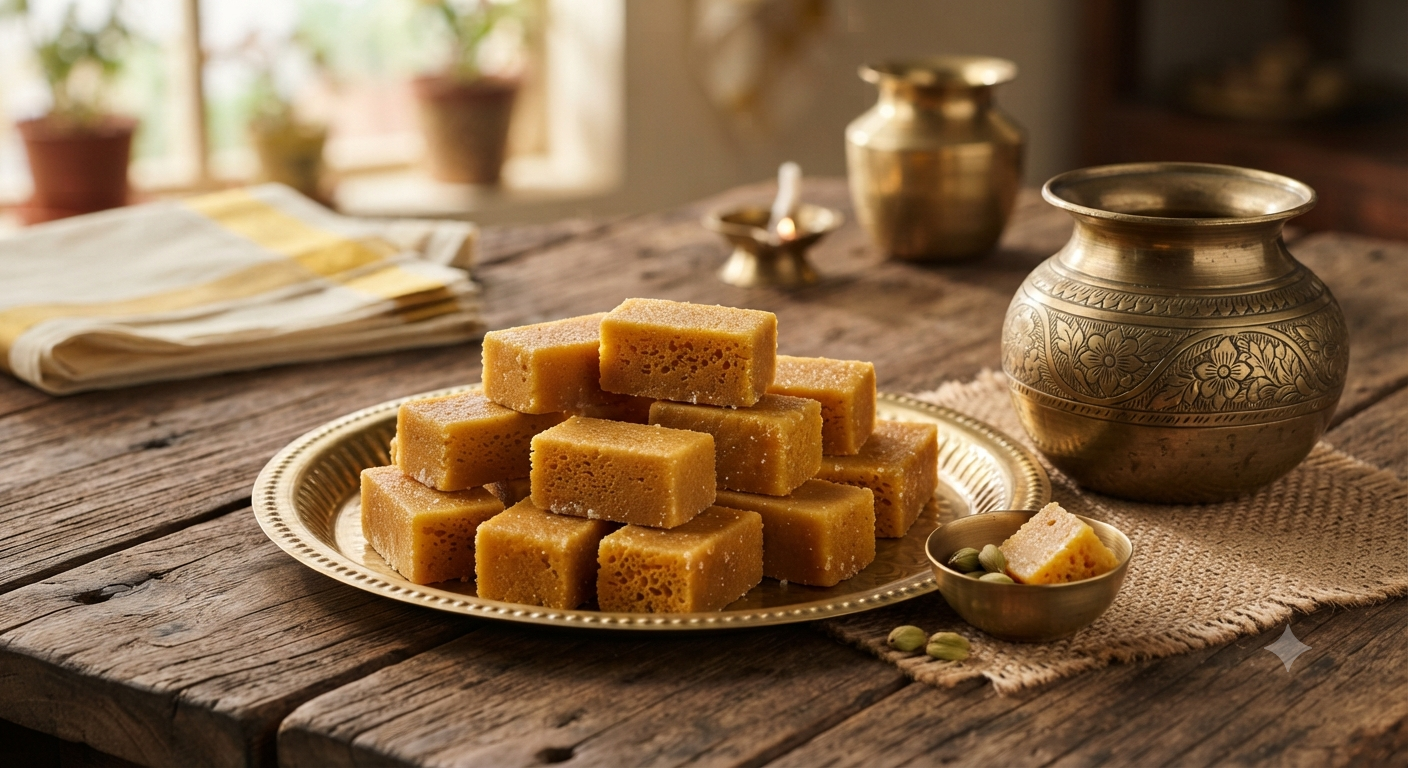
Golden, rich and irresistibly soft, Mysore Pak is one of Karnataka’s most iconic sweets. Made from just a few humble ingredients—gram flour, ghee and sugar—it has a royal story that takes us back to the kitchens of the Kingdom of Mysore.
What began as a sweet prepared for royalty eventually travelled far beyond the palace walls, becoming a beloved part of South Indian cuisine.
Today, Mysore Pak is synonymous with celebrations, festivals, weddings and special occasions across Karnataka and beyond.
A Sweet Born in the Royal Kitchen
The story of Mysore Pak is closely associated with the Mysore Palace and the royal kitchen of the Wadiyar dynasty.
According to popular historical accounts, the sweet was created during the reign of Krishnaraja Wadiyar IV, who ruled Mysore in the early 20th century.
The royal cook Kakasura Madappa is traditionally credited with creating the original sweet.
The story goes that Madappa was asked to prepare something special for the king. Working with ingredients available in the royal kitchen, he combined besan (gram flour), ghee and sugar to create a rich sweet unlike anything else.
The king reportedly enjoyed it and asked what the new creation was called.
Madappa is said to have called it Mysore Pak—with “Mysore” referring to the kingdom and “pak” or “paka” referring to the sweet mixture or syrup used in its preparation.
A simple kitchen experiment had created a sweet that would eventually become a culinary symbol of Mysuru.
What Is Mysore Pak Made Of?
The traditional recipe is remarkably simple.
The three essential ingredients:
Besan (Gram Flour)
Provides the nutty base and distinctive flavour.
Ghee
The ingredient responsible for Mysore Pak’s rich aroma, buttery mouthfeel and characteristic texture.
Sugar
Creates the sweetness and helps determine whether the final sweet becomes soft, porous and melt-in-the-mouth or firmer and more crumbly.
Despite the short ingredient list, making excellent Mysore Pak is not as easy as it sounds.
The technique matters just as much as the ingredients.
The Secret Is in the Ghee
Ask anyone who appreciates good Mysore Pak and the conversation will eventually turn to ghee.
Traditional Mysore Pak is generously prepared with ghee. It is gradually incorporated into the gram-flour and sugar mixture while it cooks.
The quantity and timing of the ghee influence the final texture.
A well-made piece can be incredibly soft and porous, almost dissolving on the tongue.
Other versions are firmer and slightly crumbly, offering a more substantial bite.
Both styles have their fans.
How Mysore Pak Is Traditionally Prepared
The process begins by carefully roasting gram flour, often with ghee, to remove the raw flavour and develop its aroma.
Sugar is then cooked into a syrup before the roasted flour is incorporated.
Ghee is gradually added while the mixture is continuously stirred.
This is where the skill of the sweet maker becomes important.
The mixture must be cooked to the right stage—not too little and not too much. Once it reaches the desired consistency, it is transferred into a tray, allowed to set and then cut into characteristic rectangular pieces.
The final result is a golden sweet with an intensely rich aroma.
Soft Mysore Pak vs. Firm Mysore Pak
Not all Mysore Pak tastes the same.
Depending on the recipe and preparation technique, you may encounter two broad styles.
Soft Mysore Pak
This version is rich in ghee and has a porous, almost fudge-like texture.
It is soft enough to melt in your mouth and is often considered the luxurious style of Mysore Pak.
Firm Mysore Pak
The firmer version holds its shape more strongly and has a slightly crumbly texture.
It is easier to package and transport and is commonly found in sweet shops across Karnataka and South India.
Neither style tells the entire story of Mysore Pak. The texture can vary considerably between makers.