


The Living Root Bridges of Meghalaya
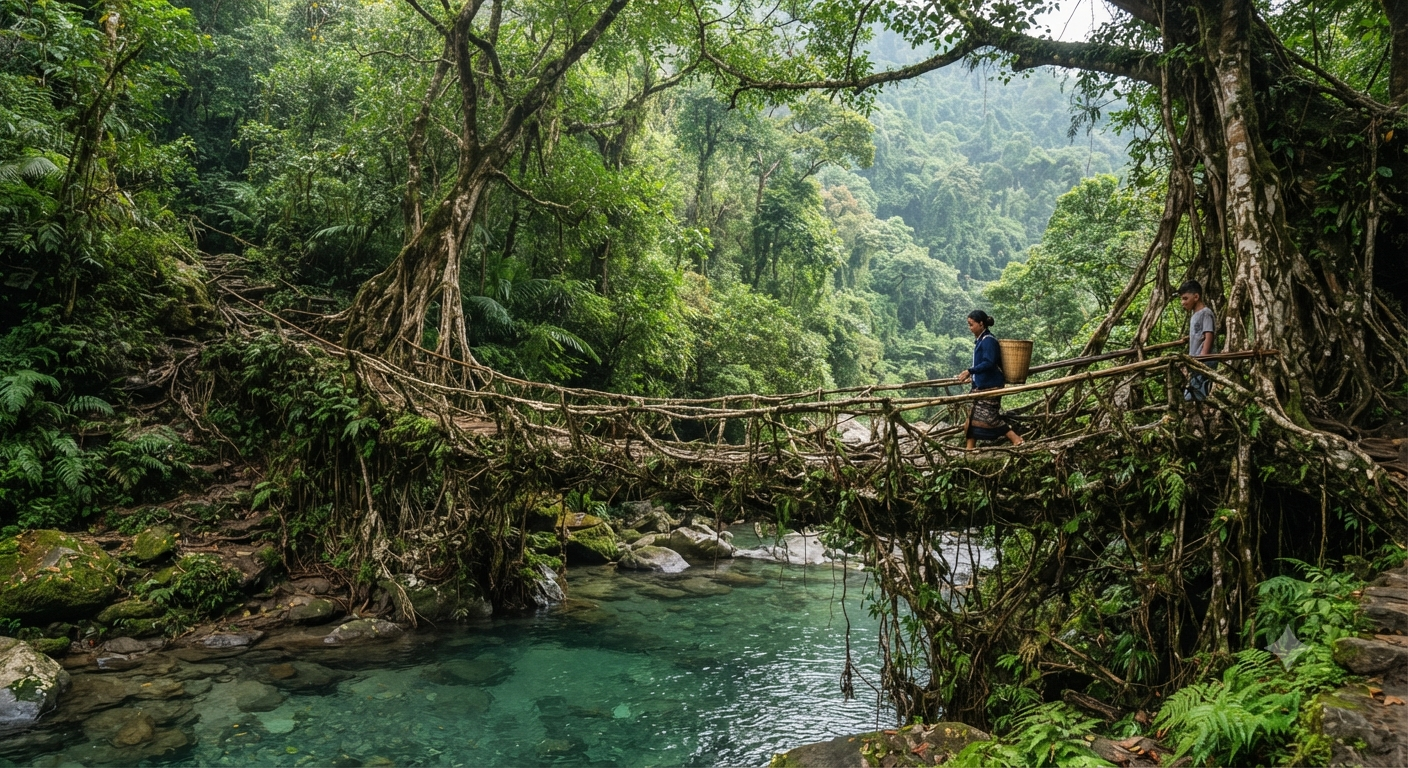
Where nature and human ingenuity grow together
Imagine walking through a misty forest in Meghalaya and suddenly coming across a bridge that isn’t made of concrete, steel, or wood—but is actually alive.
Hidden among the green hills of Meghalaya are the remarkable Living Root Bridges, created by the Khasi communities by carefully guiding the roots of rubber fig trees across streams and valleys. Over the years, those roots grow, intertwine and become strong enough to carry people across.
And that’s what makes these bridges so fascinating. They aren’t simply built. They are grown.
A bridge that takes years to come alive
Creating a living root bridge is a lesson in patience. Local communities guide the aerial roots of the Ficus elastica tree using temporary supports, allowing them to gradually reach the other side of a stream.
It can take many years for the roots to form a usable bridge, but the wait doesn’t end there. As the tree continues to grow, the bridge can become stronger and more established.
For generations, this knowledge has been passed down through the Khasi communities, making the bridges much more than a tourist attraction. They are a beautiful example of how people can work with nature rather than against it.
The famous Double-Decker Bridge
Among Meghalaya’s many root bridges, the Nongriat Double-Decker Living Root Bridge is perhaps the most spectacular.
Deep inside the forest near Sohra (Cherrapunji), two levels of living roots form a unique natural crossing. Getting there isn’t exactly an easy walk—you’ll need to make your way down thousands of steps through the lush Meghalaya landscape.
But for those who make the journey, the reward is unforgettable.
The sound of flowing water, dense tropical greenery, mist hanging between the hills and the sight of a bridge made from living trees make the experience feel almost unreal.
More than just a tourist attraction
The Living Root Bridges tell a bigger story about Meghalaya.
They represent generations of traditional knowledge, patience and a close relationship with the natural environment. Instead of cutting down trees to create a bridge, local communities learned how to shape and guide living trees to do the job.
Some of these bridges have been maintained for generations, with new roots encouraged to grow and strengthen the existing structure.
It’s traditional engineering—but unlike anything you’ll find in a modern construction manual.
The journey is part of the experience
The bridge itself may be the destination, but the journey to Nongriat is just as memorable.
The trail winds through forests, crosses smaller bridges and follows streams deep into the valley. It can be physically demanding, especially on the way back up, but the landscape constantly gives you a reason to stop and look around.
And if you continue beyond the Double-Decker Bridge, Rainbow Falls offers another spectacular reward.
Quick facts
📍 Where: Nongriat, near Sohra (Cherrapunji), Meghalaya
🌳 Tree: Rubber fig (Ficus elastica)
🥾 Experience: Trekking, nature and local culture
🌉 Highlight: Nongriat Double-Decker Living Root Bridge
💧 Nearby: Rainbow Falls
👥 Community: Khasi people
Why it belongs on your India travel list
India has no shortage of impressive monuments, but some of its most extraordinary creations don’t have walls, domes or carved stones.
The Living Root Bridges of Meghalaya are a reminder that architecture doesn’t always have to be built.
Sometimes, it can grow.