


Kovilpatti Kadala Mittai: Tamil Nadu’s Famous Peanut Candy
There are some foods that are more than just something to eat. They carry the story of a place, its people, traditions and generations of craftsmanship.
Kovilpatti Kadalai Mittai is one such food.
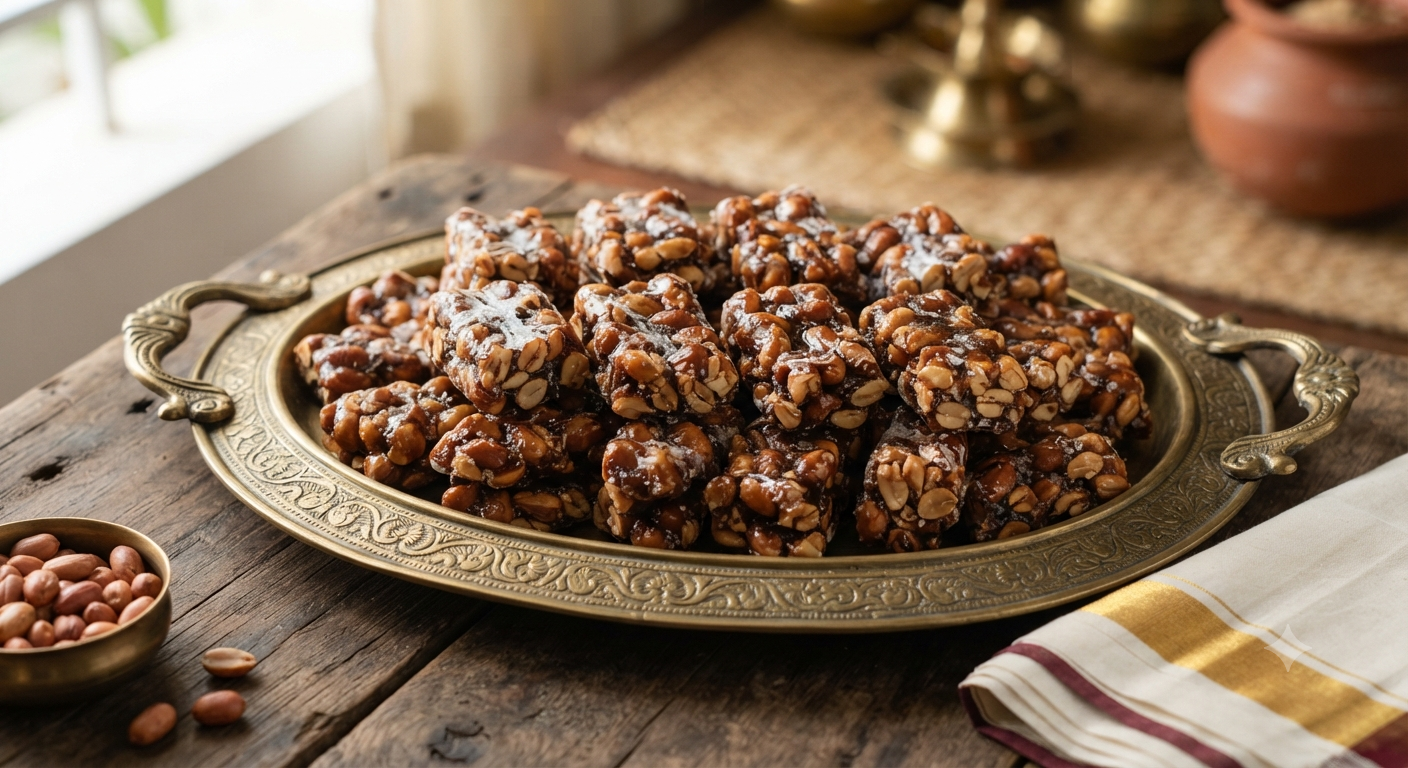
Made with roasted groundnuts and jaggery, this simple-looking sweet has become one of Tamil Nadu’s best-known traditional delicacies. Its home is Kovilpatti, a town in the Thoothukudi district of southern Tamil Nadu, where generations of makers have perfected the art of turning peanuts and jaggery into a deliciously crunchy candy.
Today, Kovilpatti Kadalai Mittai has an official Geographical Indication (GI) registration, recognizing its strong connection with the region and its traditional method of production. The GI registration is recorded as Application No. 486, Class 30 (Food Stuffs).
A Sweet With a Story
Kadalai Mittai literally refers to a sweet made from kadalai (groundnut/peanut). Similar peanut-and-jaggery sweets are found in different parts of India, but the Kovilpatti version has developed its own identity.
The documented history of Kovilpatti Kadalai Mittai goes back several decades. According to the GI application, the sweet was traditionally prepared during village festivals using locally available groundnuts and palm jaggery.
A significant change came around the 1940s, when a Kovilpatti grocery-store owner named Ponnambala Nadar began making the sweet using peanuts and sugarcane jaggery. He is also credited with popularising the rectangular form of the sweet instead of the traditional round balls.
What began as a local treat gradually became a speciality associated with Kovilpatti.
What Makes Kovilpatti Kadalai Mittai Special?
At first glance, the ingredients seem incredibly simple:
Peanuts + Jaggery + Water
But the magic lies in the ingredients, proportions and technique.
The groundnuts used for the traditional preparation are carefully selected and roasted before being combined with hot jaggery syrup. The GI documentation describes the use of groundnuts sourced from areas around Kovilpatti and neighbouring parts of southern Tamil Nadu, along with specific jaggery varieties.
Some traditional preparations also use ingredients such as glucose, cardamom or vanilla in small quantities.
The result is a sweet that is:
- Crunchy
- Nutty
- Caramel-like
- Naturally sweet from jaggery
- Slightly smoky and roasted in flavour
And, importantly, it has a texture that makes every bite satisfying.
From Peanut to Mittai: How It Is Made
Making Kadalai Mittai may look straightforward, but achieving the right texture requires experience.
1. Selecting the Groundnuts
The process begins with good-quality groundnuts. They are shelled and cleaned before being roasted.
Roasting is important because it develops the characteristic nutty aroma and gives the finished candy its satisfying crunch.
2. Preparing the Jaggery Syrup
Jaggery is melted with water and cooked while being continuously stirred.
This is one of the most important stages.
The syrup has to reach the correct consistency. If it is undercooked, the finished candy can become soft or sticky. If it is overcooked, it can become excessively hard or bitter.
Traditional makers rely heavily on experience to judge the syrup.
3. Bringing Peanuts and Jaggery Together
The roasted groundnuts are added to the hot jaggery mixture and thoroughly combined.
At this point, the kitchen fills with the unmistakable aroma of roasted peanuts and caramelised jaggery.
4. Shaping the Mittai
The hot mixture is transferred and shaped while it is still workable.
Kovilpatti Kadalai Mittai is particularly associated with rectangular pieces, although peanut-jaggery sweets are also traditionally made into balls in other regions.
Once cooled and set, the candy develops its characteristic firm crunch.
The Taste of Kovilpatti in Every Bite
The appeal of Kovilpatti Kadalai Mittai is its balance.
The jaggery brings a deep sweetness, while roasted peanuts provide a rich, earthy flavour and crunch. Unlike many elaborate Indian sweets, it does not depend on a long list of ingredients.
That simplicity is part of its charm.
Some versions are also decorated with finely grated coconut, occasionally coloured in shades such as pink, green and yellow, giving the traditional sweet a distinctive appearance.
For generations, Kadalai Mittai has been part of everyday life as well as local celebrations.
Its story is closely connected with village festivals and the food traditions of southern Tamil Nadu. What makes it particularly interesting is how an uncomplicated combination of locally familiar ingredients evolved into a product strongly identified with one town.
It is also an example of how India’s regional food traditions can become cultural signatures.
Just as certain places are instantly associated with particular foods, Kovilpatti is inseparable from Kadalai Mittai.
A Taste Worth Taking Home
If you travel through southern Tamil Nadu, Kovilpatti Kadalai Mittai is one of those foods worth looking out for.
It is easy to carry, keeps well when properly packaged, and makes a memorable edible souvenir.
But more importantly, every packet represents something larger than a sweet.
It represents the knowledge of traditional makers, the agricultural produce of the region and a food tradition that has travelled far beyond its hometown.
The Incredible Story Behind a Simple Sweet
Kovilpatti Kadalai Mittai proves that extraordinary food does not always require complicated recipes.
Sometimes, all it takes is a handful of peanuts, good jaggery and generations of knowledge.
From village festivals to shops across Tamil Nadu and beyond, this crunchy peanut candy has transformed a simple local sweet into a symbol of Kovilpatti’s culinary identity.
So, the next time you unwrap a piece of Kadalai Mittai, don’t just think of it as a peanut candy.
Think of Kovilpatti—and the generations of people who turned a few humble ingredients into one of Tamil Nadu’s most recognisable traditional sweets.