

Theyyam – When Gods Come Alive in North Kerala
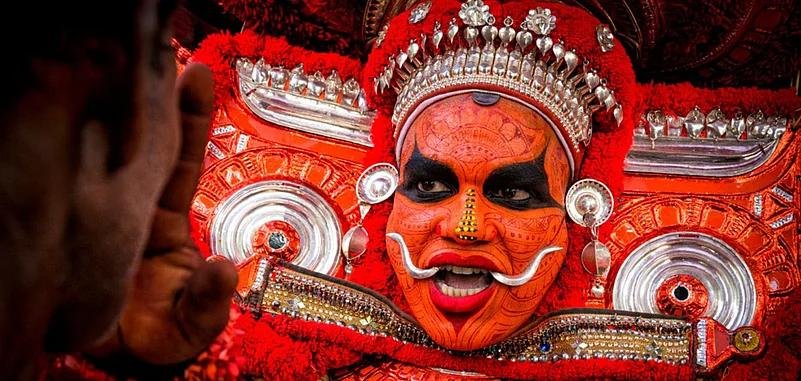
As drums echo through the night and a performer emerges in an extraordinary costume of colour, fire and intricate makeup, the atmosphere of a North Kerala village can suddenly feel otherworldly.
This is Theyyam, one of Kerala’s most distinctive ritual traditions — a spectacular combination of worship, folklore, music, dance and visual artistry.
For devotees, the performer is not simply an artist. During the ritual, the Theyyam is believed to embody the divine presence of the deity being worshipped.
What Is Theyyam?
Theyyam is a traditional ritual performance primarily associated with North Kerala, particularly the districts of Kannur and Kasaragod.
The word refers to a broad tradition comprising numerous distinct forms, each associated with particular deities, stories and local traditions.
Unlike a conventional stage performance, Theyyam takes place as part of a ritual at sacred groves, family shrines and temples.
The performer undergoes elaborate preparation before appearing before the devotees.
When Gods Come Alive
The central idea behind Theyyam is the transformation of the performer into the embodiment of a deity.
Through ritual preparation, elaborate makeup, costumes, headgear, music and movement, the performer enters a highly symbolic state.
Devotees approach the Theyyam to seek blessings, guidance and protection.
This is what gives the tradition its powerful expression: the boundary between performer and deity becomes intentionally blurred during the ritual.
A Spectacle of Colour
One of the first things that captures a visitor’s attention is the extraordinary visual appearance of Theyyam.
Performers may wear enormous circular headpieces, colourful garments, elaborate body decorations and striking face paintings.
Red is particularly prominent in many Theyyam forms, while intricate patterns and bold facial designs create a dramatic appearance.
Some headgear can be remarkably large, making the performer appear almost larger than life.
The Sound of the Chenda
Theyyam is inseparable from its music.
Traditional percussion instruments, particularly the chenda, create the rhythmic foundation of the performance.
The increasing intensity of the drums, combined with chanting and ritual movements, gradually builds an atmosphere of anticipation.
For visitors experiencing Theyyam for the first time, the sound can be as memorable as the visual spectacle.
Stories of Gods, Heroes and Local Legends
Theyyam is also a living repository of Kerala’s oral traditions.
Different Theyyam forms are associated with stories of deities, heroes, ancestors and legendary figures.
Many of these stories are deeply connected with the history and social traditions of particular communities and villages.
As a result, Theyyam is not one single performance but a vast collection of local traditions passed down through generations.
More Than a Performance
It can be tempting for visitors to view Theyyam simply as a colourful cultural show.
That would miss an important part of its meaning.
Theyyam is fundamentally a ritual tradition, and its significance comes from the relationship between the performer, the community and the deity.
The elaborate costume and dramatic movements are therefore not merely entertainment. They are elements of a ritual with deep cultural and religious significance.
Where Can You Experience Theyyam?
Theyyam is particularly associated with Kannur and Kasaragod in North Kerala.
Performances are traditionally held during the Theyyam season, which generally falls between the cooler months and extends into the early part of the year.
Many performances take place at small local shrines and sacred spaces rather than conventional tourist venues.
This makes the experience especially intimate and rooted in the communities where the tradition has evolved.
A Tradition Passed From Generation to Generation
Theyyam has survived through generations largely because it remains connected to local communities rather than existing only as a cultural performance for visitors.
The knowledge of costumes, makeup, rituals, songs and performance practices is traditionally passed down within communities associated with the tradition.
This continuity has helped preserve Theyyam as an important part of the cultural identity of North Kerala.
Things Visitors Should Remember
If you are visiting a Theyyam performance, remember that you are entering a religious and community setting.
- Respect the rituals and devotees.
- Dress appropriately.
- Follow instructions from temple or shrine authorities.
- Avoid interrupting the performance for photographs.
- Ask before taking close-up photographs of performers or devotees.
- Remember that Theyyam is a sacred ritual, not simply a tourist attraction.
When to Visit
The Theyyam season generally runs from around October/November through April/May, although the exact dates vary according to the shrine and local calendar.
The best way to experience an authentic performance is to check the schedule of individual temples, kavus and family shrines in Kannur and Kasaragod.
A Living Tradition of North Kerala
Theyyam is one of those rare cultural experiences where mythology, ritual, music, craftsmanship and community life come together in a single extraordinary event.
Under the glow of lamps and the rhythm of drums, a performer dressed in towering headgear and vivid colours becomes, for devotees, the living presence of a deity.
That is why Theyyam is remembered not simply as a dance or performance, but as an experience that reveals something profound about the living cultural heritage of North Kerala.
Here, the gods do not merely belong to stories — for a moment, they come alive.